Concerted efforts’ needed to meet 2030 Global Goals in Asia-Pacific region
Speak Out

Express your self.Say what is in your mind
Wednesday, March 25, 2020

Saturday, March 7, 2020
Coronavirus update: WHO chief calls for private sector to step up, and, should you take that flight?
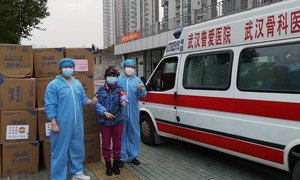
On Feb 26, a shipment of adult diapers donated by UNFPA arrived in Wuhan and was distributed to local hospitals.
6 March 2020
In his daily briefing to the press on Friday, World Health Organization (WHO) chief, Tedros Adhanom Ghebreyesus, warned that supplies of medicine are at risk of disruption due to the epidemic, given that China - the worst hit nation so far - is a major producer of pharmaceutical ingredients.
So far, no imminent specific shortages have been identified, and manufacturing has resumed in most parts of China, but the private sector needs to be involved, to ensure that countries can access life-saving products, said Tedros.
“You’ve heard me talk about the market failure for personal protective equipment. We look forward to businesses stepping up to play their part. We need you”.
The WHO chief announced that the agency is working with the World Economic Forum to engage companies around the world. Earlier this week, he spoke to more than 200 CEOs, to discuss ways that they can protect their staff and customers, ensure business continuity, and contribute to the response.
Although some sources are reporting that there are now more than 100,000 global cases, Tedros announced a global total of 98,023 during his Friday briefing.
During the latest 24-hour reporting period, the WHO has noted 2,736 new cases of COVID-19, present in a total of 47 countries and territories.
Italy needs to focus on containment

On their return from a 12-day mission to Italy, a WHO Rapid Response Team has concluded that the country should maintain a strong focus on containment measures, nationwide.
The mission team, made of up UN health agency experts and the European Centre for Disease Prevention and Control, was sent to Italy to strengthen understanding about the evolution of the disease and support the national response.
As well as containment, the team also recommended making the identification and testing of suspect cases a priority, as well as the isolation of patients, and ensuring that hospitals are sufficiently prepared.
The WHO regional team is planning to establish a field emergency team in its Venice office, and send a senior advisor to work with the Italian authorities in Rome.
UN aviation body calls for greater international cooperation
With global travel slowing in response to the spread of COVID-19 coronavirus, the UN civil aviation body (ICAO) and WHO, called on Friday, for greater international cooperation to contain the virus and protect the health of travellers.
In the joint statement, ICAO noted that it is working closely with governments and industry partners to provide guidance to aviation authorities, airlines, and airports on appropriate measures aimed at reducing the risk of transmission.
As well as reaffirming the importance of international collaboration, ICAO and WHO underlined the importance of cooperation at a national level, between aviation, health, and other relevant authorities.
Should I take a flight?
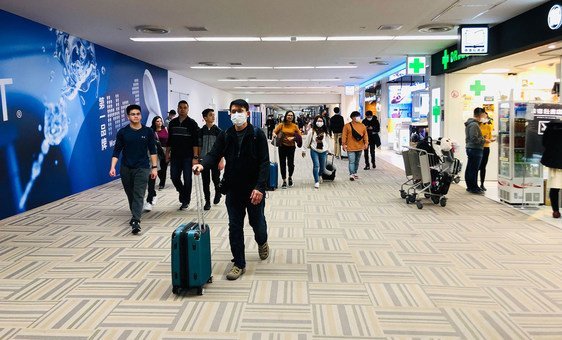
In response to fears surrounding the spread of COVID-19, ICAO has published a list of questions and answers, designed to ensure appropriate planning and action at all levels, from Member States to aircraft operators and the general public.
Recommendations for passengers include maintaining good standard hygiene practices, such as covering the mouth when sneezing, and regular hand-washing; and consulting with medical professionals before flying, especially when the traveller has recently visited a badly-affected area, or been in contact with someone diagnosed with COVID-19 in the previous 14 days.
As for the risk of taking a flight, ICAO describes the likelihood of contracting the virus while flying as extremely low, given that aircraft cabins have highly effective air filter systems that remove airborne virus particles, and that aircraft are disinfected between flights, if needed, in accordance with ICAO standards.
The full list of ICAO’s COVID-19 question and answers can be found here.
Courtesy:UN News
Rights office concerned over death sentences against 35 Yemeni MPs
Rights office concerned over death sentences against 35 Yemeni MPs

A boy pushes a wheelbarrow filled with jerrycans in Sanaa, the Yemeni, capital.
6 March 2020
The UN human rights office is calling on authorities in Yemen to revoke death sentences imposed against 35 parliamentarians allegedly for treason charges.
The pro-government MPs were sentenced in absentia earlier this week by the Houthi-controlled Specialized Criminal Court in the capital, Sana’a.
#Yemen: Very concerned that 35 parliamentarians were sentenced to death – in absentia – on treason charges. We call on the de facto authorities to immediately quash the sentences against the MPs, and to ensure their families are no longer harassed
ow.ly/r5P250yEzs3

114 people are talking about this
“We are extremely concerned by the overall conduct of the trial and that it is politically motivated, as well its failure to comply with international norms and standards”, human rights spokesperson Liz Throssell told journalists in Geneva on Friday.
Yemen’s government, backed by a Saudi-led coalition, has been embroiled in a years-long conflict with Houthi rebel forces.
The politicians reportedly were charged with “having taken actions threatening the stability of the republic of Yemen, its unity, and security of its territory” relating to their participation in a meeting last April with the country’s internationally-recognized President Abdo Rabo Mansour Hadi.
“Following the issue of the sentences in Sana’a, we received reports that the homes of some parliamentarians in Sana’a were ransacked by a group of the Houthi women police, and their family members, who were inside their homes, given 24 hours to leave their property”, said Ms. Throssell.
The human rights office said the death penalty is an extreme form of punishment reserved for the “most serious crimes” involving intentional killing and should only be imposed, if at all, after a fair trial that respects stringent due process
Courtguarantees.
Friday, March 6, 2020
Javier Pérez de Cuéllar praised as ‘accomplished statesman’ who had ‘profound impact’ on the world
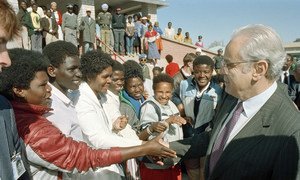
The UN Secretary-General Javier Perez de Cuellar visits Katatura, a black township of Windhoek, Namibia in July 1989.
5 March 2020
Javier Pérez de Cuéllar, the fifth United Nations Secretary-General, praised for his ability to foster dialogue and for leading the Organization through a turbulent decade, has passed away at the age of 100.
A veteran Peruvian diplomat, lawyer and professor, he is the first and only Latin American to hold the top UN job so far.
In a statement Wednesday evening, current UN Secretary-General António Guterres said that he was profoundly saddened at Mr. Pérez de Cuéllar’s passing and praised the former UN chief as “an accomplished statesman, a committed diplomat and a personal inspiration who left a profound impact on the United Nations and our world.”
Born in Lima, Peru, on 19 January 1920, he was appointed to lead the UN after 42 years of diplomatic service.
Distinguished diplomatic career
“Mr. Pérez de Cuéllar’s life spanned not only a century but also the entire history of the United Nations, dating back to his participation in the first meeting of the General Assembly in 1946,” said Mr. Guterres.
Over the course of his career, in addition to being his country’s Ambassador to Switzerland - as well as the then Soviet Union, Poland and Venezuela - Mr. Pérez de Cuéllar held many high level positions in Peru’s Ministry of Foreign Affairs, including Permanent Representative to the United Nations in 1971.
During his month presiding over the UN Security Council, in July 1974, he ably-managed the crisis in Cyprus. A year later, he was appointed as the Secretary-General’s Special Representative in Cyprus for two years, then went on to become the UN chief of Political Affairs and Representative of the UN in Afghanistan.
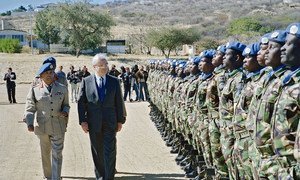
Javier Perez de Cuellar, the Secretary-General Visits the UN Transition Assistance Group (UNTAG) Military Headquarters in Suiderhof Base, Windhoek, Namibia in July 1989.
The Cold War period and the growing role of the UN
Mr. Guterres said that his predecessor’s tenure as Secretary-General coincided with two distinct eras in international affairs: first, some of the iciest years of the Cold War, and then, with the ideological confrontation at an end, a time when the UN began to play more fully the role envisaged by the founders.
In 1982, his tenure as UN chief started with intense negotiations between the United Kingdom and Argentina over the disputed sovereignty of the Falkland Islands/Malvinas. Persistent through the countless challenges, Mr. Pérez de Cuéllar produced a now famous phrase, referring to the peace talks: “The patient is in intensive care but still alive.”
Despite health issues, he agreed to serve for a second term as UN chief. In his acceptance speech in 1986, he referenced the financial crisis that the UN was going through at the time, saying that “to decline in such circumstances would have been tantamount to abandoning a moral duty toward the United Nations.”
Reiterating his “unshakable faith” in the “permanent validity” of the Organization, he added that the UN’s “difficult situation” provided a “creative opportunity for renewal and reform.”
“Mr. Pérez de Cuéllar played a crucial role in a number of diplomatic successes — including the independence of Namibia, an end to the Iran-Iraq War, the release of American hostages held in Lebanon, the peace accord in Cambodia and, in his very last days in office, a historic peace agreement in El Salvador,” said the current UN chief.
His second term was also marked by the withdrawal of Soviet troops from Afghanistan. Among others, his team facilitated political stability in Nicaragua .
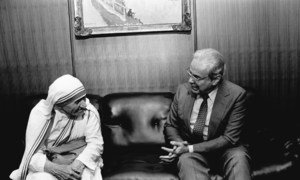
Javier Perez de Cuellar, Secretary-General of the United Nations Meets with Mother Teresa in October 1985.
In 1987, he was awarded the Prince of Asturias Prize for the promotion of Ibero-American co-operation. In 1989, he received the Olof Palme Prize for International Understanding and Common Security, and the Jawaharlal Nehru Award for International Understanding.
Long after his term as Secretary-General ended in 1991, he remained true to the values of the UN, and continued advocating for peace, justice, human rights and human dignity throughout his life. Decorated by some 25 countries, he was also the recipient of several honorary degrees.
In his speech to the Nobel Committee, which awarded the Nobel Peace Prize to UN Peacekeeping Operations in 1989, he defined the role of inter-governmental organizations like the United Nations as being to “draw the line between struggle and conflict.” Thanks to his unyielding determination, he helped many nations “stay on the right side of that line”.
“I extend my deepest condolences to Mr. Pérez de Cuéllar’s family, the Peruvian people and so many others around the world whose lives were touched by a remarkable and compassionate global leader who left our world a far better place,” said Mr. Guterres.
Courtesy:UN News
Courtesy:UN News
Unanimous’ ICC gives go-ahead to probe Afghanistan alleged war crimes
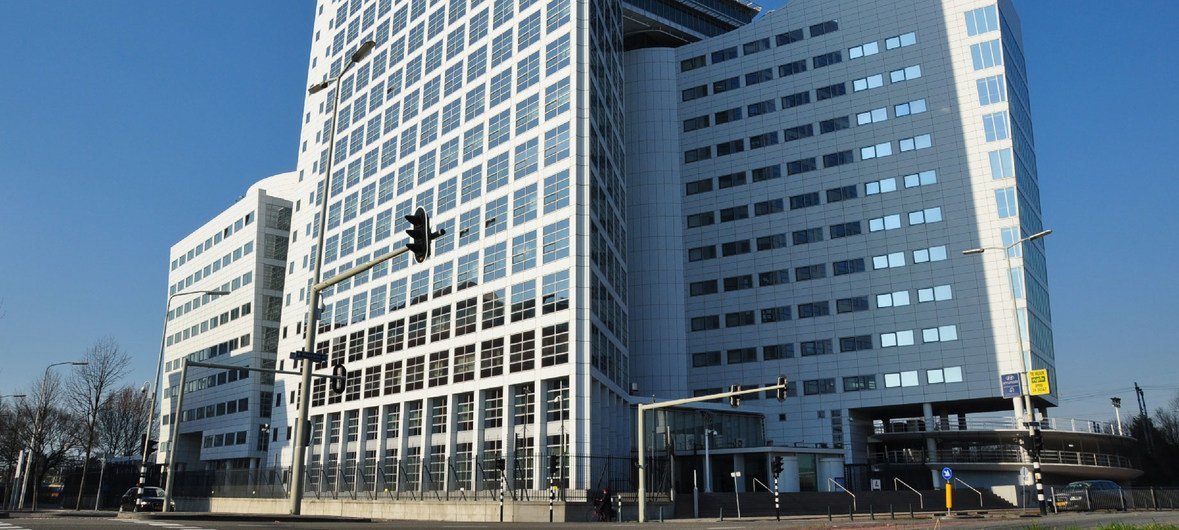
Headquarters of the International Criminal Court in The Hague.
5 March 2020
Prosecutors have been given the green light to investigate alleged war crimes and crimes against humanity in Afghanistan - and beyond its borders – linked to Afghan, Taliban and US troops, the International Criminal Court said on Thursday.
The decision, reached unanimously on appeal by judges at the International Criminal Court (ICC) in The Hague, overturns an earlier decision vetoing an inquiry, on the grounds that it “would not be in the interests of justice”.
Statement of #ICC Prosecutor #FatouBensouda following the Appeals Chamber’s decision authorising an investigation into the Situation in #Afghanistanicc-cpi.int/Pages/item.asp…


“Today is an important day for the cause of international criminal justice” – #ICC Prosecutor #FatouBensouda, following the Appeals Chamber’s decision authorising an investigation into the Situation in #Afghanistan. Watch the full statement


29 people are talking about this
“The Appeals Chamber found that the Prosecutor is authorised to investigate…the crimes alleged to have been committed on the territory of Afghanistan since 1 May 2003,” the ICC said in a statement, “as well as other alleged crimes that have a nexus to the armed conflict in Afghanistan and are sufficiently linked to the situation in Afghanistan and were committed on the territory of other States Parties.”
Investigation appeal first made in 2017
The probe will be led by ICC Prosecutor Fatou Bensouda, who made the request to to the ICC’s Pre-Trial Chamber in November 2017.
At the time, her Office cited grave crimes “and the absence of relevant national proceedings against those who appear to be most responsible for the most serious crimes”.
The ICC Prosecutor’s request covered alleged abuses committed in Afghanistan since 1 May 2003, as well as other alleged crimes since 1 July 2002, which were committed by States Parties to the Rome Statute – the 1998 international agreement that led to the formation of the court.
Afghan, Taliban and US forces in spotlight
Specifically, Ms. Bensouda will be seeking to investigate crimes against humanity and war crimes by the Taliban and their affiliated Haqqani Network; war crimes by the Afghan National Security Forces (ANSF) and in particular, members of the National Directorate for Security (NDS) and the Afghan National Police (ANP).
The ICC Prosecutor is also set to probe alleged war crimes by U.S. military personnel in Afghanistan and by members of the Central Intelligence Agency (CIA) in “secret detention facilities” in Afghanistan “and on the territory of other States Parties to the Rome Statute, principally in the period of 2003-2004”.
In an earlier statement, Ms. Bensouda’s Office said that “that there are no substantial reasons to believe that the opening of an investigation would not serve the interests of justice, taking into account the gravity of the crimes and the interests of victims”.
The Prosecutor maintained that her Office’s sole objective was to investigate and prosecute alleged war crimes and crimes against humanity “independently, impartially and objectively”.
U.S. Secretary of State Michael Pompeo has issued a statement calling the court’s decision “a truly breathtaking action by an unaccountable political institution, masquerading as a legal body”, adding that it “is all the more reckless” as it came just days after the signing of a “historic peace deal” between Washington and the Taliban.
“This is yet another reminder of what happens when multilateral bodies lack oversight and responsible leadership, and become instead a vehicle for political vendettas. The ICC has today stumbled into a sorry affirmation of every denunciation made by its harshest critics over the past three decades”, he stated.
Court can issue summons to ‘no matter who’
For the purposes of its investigation, the ICC Prosecutor can request that the court’s judges issue summons to appear or arrest warrants “no matter who the perpetrator”, for alleged atrocity crimes committed in connection with the Situation in Afghanistan, her Office said.
In addition to Afghanistan, the ICC Prosecutor’s Office has been conducting investigations in Burundi, Uganda; the Democratic Republic of the Congo, Darfur, Sudan; the Central African Republic, Kenya, Libya, Côte d'Ivoire, Mali and Georgia.
Preliminary examinations have also begun into the registered vessels of Comoros, Greece and Cambodia; as well as into Colombia, Gabon, Guinea, Iraq/UK, the Occupied Palestinian Territories, Nigeria and Ukraine.
Courtesy:,UN News
Subscribe to:
Posts (Atom)
Concerted efforts’ needed to meet 2030 Global Goals in Asia-Pacific region
Concerted efforts’ needed to meet 2030 Global Goals in Asia-Pacific region
-
Colombia: from illicit drugs to sustainable livelihoods » Vof News | Voice Of Freedom
-
Concerted efforts’ needed to meet 2030 Global Goals in Asia-Pacific region
-
Notes and beats of misrepresentation in Malayalam films » Vof News | Voice Of Freedom
